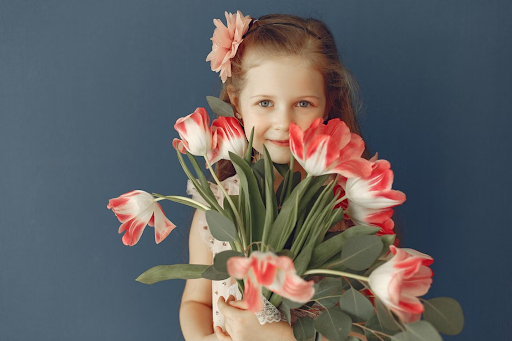
Hand a child a pile of flowers and something predictable happens. They don’t sort by species or think about symmetry. They go straight for colour, grabbing whatever catches their eye first, then adjusting by feel rather than by rule. The result rarely looks like anything a florist would sign their name to, and that’s exactly the point. A bouquet built by a child isn’t meant to be polished. It’s meant to be theirs, from the first stem chosen to the slightly lopsided knot holding it all together.
Letting kids build their own small bouquet, rather than just watching an adult arrange one, is a small shift that changes what the activity actually teaches. Handed a finished arrangement, a child is a spectator. Handed a bundle of loose stems and free rein, they become the one making every decision, which flower goes where, how tall is too tall, whether the yellow one clashes with the pink one or somehow makes it better. Those are small decisions, but they’re real ones, and making them repeatedly is where most of the actual learning happens.
Why Handing Over Control Matters
Adults tend to intervene almost by reflex when a child’s bouquet starts looking uneven. A stem gets nudged straighter, a colour gets swapped for one that matches better, a flower deemed too big gets quietly removed while the child isn’t looking. Each of these interventions is small and well-intentioned, but stacked together they turn what should be the child’s project back into the adult’s, with the child reduced to handing over stems on request.
There’s also a quieter cost to constant correction that’s easy to miss in the moment. A child who learns that every choice gets adjusted afterward tends to start hesitating before making the next one, checking an adult’s face for approval before committing to a flower rather than just going with instinct. That hesitation is the opposite of what the activity is meant to build. The whole value of handing over a pile of stems is that the child gets to be wrong, or at least differently right, without someone quietly correcting it a few minutes later.
Resisting that instinct is harder than it sounds, especially for anyone who already has an eye for how flowers usually go together. But the lopsided, oddly balanced bouquet a child makes on their own is worth more than a symmetrical one an adult quietly fixed behind their back. It reflects an actual set of decisions rather than adult taste wearing a child’s fingerprints. That’s also usually the version a child will proudly carry to the table themselves, rather than the corrected one that technically looks nicer but doesn’t feel like theirs anymore.
Choosing Flowers a Child Can Actually Handle
Not every flower is a good fit for small hands still learning basic coordination. Thick, woody stems resist bending or trimming, and some flowers, roses especially, come with thorns that turn a fun activity into a series of small injuries. A good starting selection avoids both problems, favouring stems that are soft enough to trim with safety scissors and sturdy enough to survive being gripped a little too tightly by an excited five-year-old.
- Daisies and chamomile: soft, thornless stems and a shape simple enough that even a very young child can recognise and sort them without help.
- Sunflowers, in smaller varieties: sturdy enough to survive rough handling, with a bold, cheerful shape that’s usually a first favourite.
- Statice and other papery flowers: dry easily and hold their shape for days, which means an early, slightly crushed attempt still looks presentable well after the fact.
- Baby’s breath: endlessly forgiving to work with and useful for filling gaps, giving even a sparse handful of larger flowers a fuller look.
- Tulips, once past full bloom: soft stems that bend easily without snapping, making them easier for smaller hands than most other bulb flowers.
- Snapdragons: an interesting, slightly unusual shape that tends to fascinate kids on its own, since squeezing the bloom gently makes it open and close like a little mouth.
A Simple Way to Start
The easiest way in doesn’t require much setup. A shallow tray or table covered with a few sheets of newspaper, a small bucket of water to keep stems fresh, a pair of blunt safety scissors, and a loose bundle of five or six flower varieties is enough. No instructions are strictly necessary, but a few loose prompts tend to help a child who isn’t sure where to start: pick your favourite colour first, then find one flower that’s tall and one that’s short, then fill in whatever gaps are left with whatever’s left over.
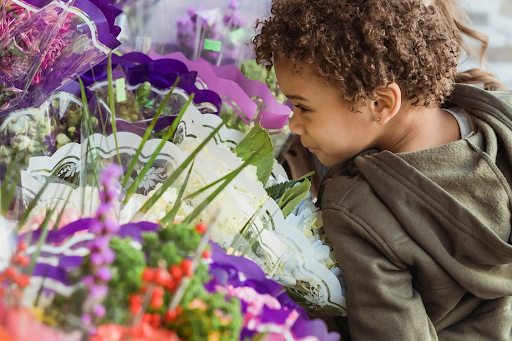
It helps to let the child choose the flowers themselves rather than handing over a pre-sorted bundle. Even a simple trip to a grocery store flower bucket or a local market, letting a child point at whatever colours catch their eye, turns the shopping itself into part of the activity rather than a chore done beforehand by an adult. Colour is almost always the first thing a child responds to, long before they think about shape, scent, or how well two flowers actually go together.
Purple tends to come up often in these choices, more often than adults usually expect. It’s bold enough to stand out in a bucket of mixed flowers without being as common a first pick as red or pink, which seems to give it a certain appeal, something a little less obvious than the flowers everyone else is reaching for. Lavender, purple statice, and deep violet stock all work well for this, holding their color and shape even after a fair amount of handling by small hands. For anyone stocking up before a session like this, browsing a selection of purple flowers ahead of time is an easy way to make sure that colour is well represented in the mix, rather than leaving it to chance at whatever the local shop happens to have on the day.
Letting the Process Be Messy
A child’s first attempt at a bouquet is very rarely balanced. One side will be heavier than the other, the tallest flower might end up buried in the middle, and the whole thing may lean at an angle no adult would sign off on. All of that is completely normal, and none of it needs correcting. The point of the exercise isn’t a photogenic finished product, it’s the string of small decisions that led there: this flower first, this one next to it, this one because the colour looked nice, this one because there was a gap that needed filling.
It’s worth resisting the urge to explain the ‘right’ way to do it too early. Concepts like colour balance, height variation, and focal points are things a child will discover through trial and error far more effectively than through instruction, especially at a young age when hands-on experimentation tends to stick better than verbal explanation. A few sessions in, most kids start noticing these principles on their own, without ever being told directly, simply because they’ve seen what happens when all the tall flowers end up on one side.
What Different Ages Get Out of It
The activity looks different depending on how old the child is, and it’s worth adjusting expectations accordingly rather than aiming for the same result across every age:
- Toddlers, two to four: mostly interested in the sensory side, petals, textures, colours, water, rather than the finished arrangement. Expect very short attention spans and a bouquet that may fall apart within minutes, and treat that as entirely fine.
- Young children, five to seven: starting to grasp basic groupings, tall versus short, one colour versus another, and capable of holding focus long enough to finish a small bouquet with some patience.
- Older children, eight and up: often ready for slightly more structure, matching flowers to a specific colour scheme, wrapping the finished bouquet neatly, or even choosing flowers with a particular occasion or person in mind.
Keeping Setup and Cleanup Simple
One reason this activity tends to fall by the wayside in busy households is that it sounds, on paper, like more of a production than it actually needs to be. In practice, the setup takes less time than most craft projects and produces far less mess than painting or baking. A tray or a section of table, a towel underneath in case of spills, a small pitcher of water, and whatever ribbon or twine is on hand for tying it off at the end covers the entire list. Cleanup is just as fast: stray leaves swept into a bin, the tray wiped down, done in a couple of minutes.
Keeping the setup this simple matters because it lowers the bar for how often the activity actually happens. A ritual that requires clearing an entire table, digging out specialist tools, or setting aside a full afternoon tends to get postponed indefinitely. One that can be pulled together in five minutes on a random weekday afternoon is the one that actually survives contact with a busy family calendar.
Turning It Into a Small Tradition
A single afternoon spent building a bouquet is fun on its own, but the activity holds up especially well as something repeated regularly rather than done once. A standing Saturday morning ritual, a bucket of flowers and twenty minutes before breakfast, gives a child room to actually improve over time, comparing this week’s attempt to the one from a few weeks back and noticing, often without being told, what’s changed.
It also gives the finished bouquet somewhere to go afterward, which matters more than it might seem. A bouquet made and then set aside feels different from one placed on the family table, or carried over to a grandparent, or left on a neighbour’s doorstep as a small surprise. Giving the finished result a destination turns the activity from an isolated craft project into something with a small social purpose, however modest, and that purpose tends to be what keeps kids asking to do it again the following week.
A Few Things to Avoid
A handful of small habits tend to undercut the activity without anyone quite meaning to. Worth keeping in mind:
- Fixing the bouquet after the fact: quietly rearranging a finished bouquet once the child has walked away undoes the sense of ownership that made the activity worthwhile in the first place.
- Introducing too many flowers at once: a bucket with fifteen different varieties is overwhelming for a young child. Five or six clear choices work far better than an unsorted mass.
- Rushing the activity: a bouquet built in two minutes because everyone’s in a hurry rarely holds a child’s attention or produces anything they feel proud of. It works far better as an unhurried, standalone activity than as something squeezed in before rushing out the door.
- Grading the result: comments like ‘that doesn’t really go together’ undercut the whole point. Curiosity, ‘why did you choose that one’, works far better than correction.
Why It’s Worth the Mess
None of this requires a garden, a florist’s budget, or any particular skill on the adult’s part. A bucket of grocery-store flowers, a pair of safety scissors, and twenty unhurried minutes cover almost everything needed. What a child gets out of it, some early colour sense, a bit of fine motor practice, a small object they made entirely themselves and are proud enough of to want to show someone, tends to outlast the flowers themselves by quite a lot. The bouquet wilts within a week. The habit of noticing colour, texture, and shape, and the confidence that comes from having made something whole from a pile of loose stems, tends to stick around considerably longer.